

The Article’s Claim
Okay, today we’re going to take a look at an article that I certainly find misleading when it comes to the Apostle Paul’s revelation to the church, the body of Christ. It’s written by a gentleman out of Indiana. This was sent to us from Michelle, a listener to the broadcast since 2012. She recently dealt with someone who got a bit confused after reading this article, and she sent me what she wrote to them- her response- and it was spot on. She dealt with them perfectly, didn’t need my help, but she sent this our way and asked that we address it.
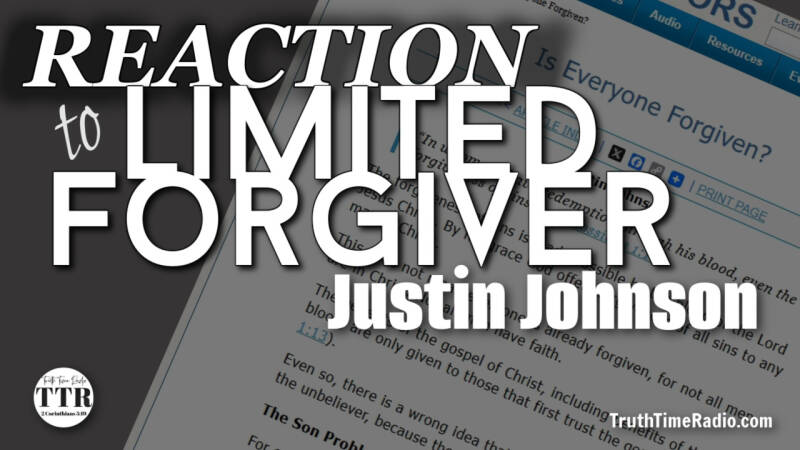
The article is titled, “Is Everyone Forgiven?” This guy starts with Colossians chapter 1 verse 14: “In whom we have redemption through his blood, even the forgiveness of sins.”
Now for his commentary, he says, “The forgiveness of sins is made possible by the blood of the Lord Jesus Christ. By his grace, God offers forgiveness of all sins to any man in Christ.”
That’s incorrect. Here, like so many, he added his own personal assertion. God’s not offering forgiveness to anyone today. Hey, if he is, then Paul wrote 13 letters and left that out. In not one of his letters to us, the church, the body of Christ, does he tell us how to get our sins forgiven.
That’s a problem here, an inconsistency. Paul doesn’t speak of forgiveness as being something we can get. Those who are in Christ have forgiveness, and those not in Christ have forgiveness. The difference is being saved or not saved. Those who are not saved have forgiveness. Sins are not being imputed to anyone in the world. Paul couldn’t have been any clearer in 2 Corinthians chapter 5 verse 19.
Salvation and Forgiveness
Today, folks are not separated by forgiven or unforgiven. They’re separated by saved and unsaved. You’re either in Christ or not in Christ, and those in Christ are believers of the gospel. Those not in Christ are not believers of the gospel. That’s the separation. It’s not about those who are forgiven and those who are not forgiven. What separates the two is that one group has been given the righteousness of God in Christ, and the other has not.
Let’s continue here. He then writes, “This does not mean everyone is already forgiven. For not all men are in Christ. Not all men have faith.”
So here he’s telling you that it’s your faith that gets your sins forgiven. Your belief has the power to get you forgiven. Not the blood of Christ, not the actions that he took on the cross, not by what he did. It’s actually by what you can do—if you believe, you can get your sins forgiven. Unbelievable.
Then he says, “The benefits of the gospel of Christ, including benefits of the blood, are only given to those that first trust the gospel,” and he cites Ephesians 1:13.
Well, Ephesians 1:13 has nothing to do with what he just said. When you read that verse, there is nothing about the benefits of the blood only being applicable to those who first trust the gospel.
He goes on to say, “Even so, there is a wrong idea that sin is no longer a problem for the unbeliever, because they are forgiven even in unbelief.”
Hey, sin is a problem for the unbeliever and the believer. But it’s not a problem for salvation. Sin has been taken out of the way. It has been put on the person of Jesus Christ, 2 Corinthians chapter 5 verse 21.
John 8 and the Cross
Next, he addresses the sin problem. This is subtle. And he says, “For centuries, the true saying has been, ‘It is no longer a sin problem, but a Son problem.’” Some preacher said this after teaching on John 8:24.
Okay, so thus far he has failed to make his point, and now he attempts to drag us back to the Old Testament doctrine of John chapter 8. John 8:24.
Listen: “I said therefore unto you, that ye shall die in your sins: for if ye believe not that I am he, ye shall die in your sins.”
Then he says, “This statement explains that the only way to receive forgiveness is through Jesus Christ, but it does not teach that all are already forgiven without faith in the gospel.”
Well, of course it doesn’t. We’re reading Old Testament doctrine from the book of John. This is John chapter 8, verse 24. No, Hebrews chapter 9, verses 16 and 17, bloodshed of Jesus Christ. No New Testament yet. So of course this doesn’t. The fact that sins are not being imputed to the world is not yet made known back here. This fact is only later made known through the writings of Paul.
It’s amazing that these guys go outside of the epistles of Paul, outside of the parentheses, to try and prove their point. That’s like going to Matthew chapter 24 to try to prove the rapture. Not going to work.
Sins, Judgment, and the Future
Okay, let’s continue. He says, “Sin is no longer the problem, because Christ is the one who will redeem them from their sins. Removing the sin problem without first faith in Christ is to ignore the second part of the bromide, the problem of the Son.”
Okay, the second part is that they need a belief in Christ when he said, “I am he.” That was precisely what they needed belief for. Not in the finished work of Christ, which at that time wasn’t finished.
Then he writes, “It is not that there is simply no longer a sin problem for anyone; it is that for everyone there is a problem of faith toward the Son. Without faith in the Son, the sin problem remains.”
Yes, the sin problem remains, and will continue to remain while we remain here on earth wrapped in this sinful flesh. But that’s not even the point. The point is the ministry of reconciliation found in 2 Corinthians chapter 5. The sin problem which stood in the way of salvation was done away with. The sin that kept God from dealing with us was put on Christ. He died for them all. He was buried with them all, and he didn’t bring any of them out of the grave.
So just where would one have to go to get those sins back? To have them reapplied so that they can stand before God and be judged? That sort of teaching is beyond the pale of ludicrous.
But there’s more. He then writes, “If someone has a curable disease and they resist the cure, they have a problem with both the cure and the disease. To accept the cure means there will not be a problem with the disease.”
Okay, let’s deal with this very bad analogy. The problem here is it has nothing to do with what took place at Calvary. This analogy is built on a faulty premise, which only leads to a straw-man argument. Hey, you didn’t have the choice of resisting the cure. It happened 2,000 years ago. You were not even present.
Furthermore, the cure was not only for us, but for God. Reconciliation is not one-sided. It’s always between two or more parties. The cure was completed almost 20 centuries ago. The decision to impute man’s sins onto Christ so that God could stop imputing them onto mankind was the cure. That solved it. No choice on your part is needed. That was the solution. God had to put sin out of the way so that he could deal with humanity concerning their salvation. Sins had to be forgiven first. The sin issue was taken out of the way; the wall that separated God and man was removed by the acceptable payment made by the blood of Jesus.
Okay, then he says, “The unbeliever still has a problem with sin that can only be cured through Christ.”
Again, we all have a problem with sin, but it doesn’t stand in the way of salvation. That’s what all of this is about.
The Reconciliation Argument
As concerning salvation, the enmity caused by the world’s sins was removed. They were put on Christ.
He then writes, “Just because the cure exists and is available does not mean the disease is gone. They must receive the cure to remove the sin.”
Only if we accept your faulty premise. Hey, listen, the disease was the sin that stood between God and man, and the cure was Jesus Christ our Savior. As pertaining to salvation, sin no longer stands between God and man.
Then we come to his section of the article, subtitled “Forgiveness in Hell.” He says, “Poor preaching propagates the problem by proclaiming, ‘Everyone in hell has their sins forgiven.’” What a pitiful presentation of the cross.
Well, that’s a mistake on your part. Not everyone in hell has their sins forgiven. So this is a straw man. If you have no standing for your claims, the best way to win an argument is to first build a straw man. You first build the straw man, then present facts to destroy the straw man. That appears to be the attempt here.
But let’s deal with the real man, not the straw man. The truth is that during the but-now time in which we are living, and according to our present dispensational news, no one is dying and going to hell for their sins that Jesus already died for. That defies logic.
For those who die before the close of this dispensation, they will not go to hell because of their already paid-for sins. They can’t. Their sins were put on Christ. They can’t be both on Christ and paid for by Christ, while on us at the same time.
No, but for those who do not trust Christ, do not rest their faith in him by believing Paul’s gospel, and live past the catching away of the rapture, they’ll indeed be accountable for their sins. Not sins they dragged from this dispensation into the next. No, God’s not going to re-impute sins to anyone. They’ve been paid for. The sins they’ll be held accountable for are the ones they commit during the tribulation. This dispensational truth won’t apply out there in time-future. They will no longer be under the sins-not-being-imputed promise. That time will have come and gone. It’ll be over. But they’ll commit new sins, and the sins they commit will be imputed.
Anyone who rejects Paul’s gospel, who misses the rapture and is still alive during the coming tribulation, will be held responsible for any sins they commit during that time, not for sins they committed prior. No way. Those were not imputed, remember?
Time Past, But Now, and Ages to Come
When the parentheses are lifted, when it’s removed, 1 John 1:9 will be reinstated. So get your Bible, go through the books of Hebrews through Revelation, or go back before the writings of Paul. All those books—find and collect all the verses you can, all the verses you want to, that deal with someone being judged for their sins. But understand that none of them, not a one, presents any problem whatsoever to what Paul calls the ministry of reconciliation.
All the world’s sins not being imputed is a dispensational truth. Put Paul’s letters in parentheses and realize that the world’s sins not being imputed does not apply on either side of the parentheses. This isn’t hard. The world’s sins not being imputed is a dispensational truth given to us by our apostle Paul.
And if you’re listening and you’re not saved, regardless of what some have fed you, your sin is not what’s standing in the way of your salvation. That’s not the good news. Romans 5:13: “For until the law sin was in the world: but sin is not imputed when there is no law.” It couldn’t get any clearer.
Until the law, sin was in the way, but sin is not imputed when there is no law, meaning sin has been taken out of the way. Now that’s good news. That’s 2 Corinthians chapter 5, verse 19: sins are not imputed; verse 21: they’re put onto Christ.
It’s Not Forgiveness Upon Belief
Simple question here: Is the law in effect today? Then believe your Bible: “Sin is not imputed when there is no law.” That’s easy. Romans 4:15, Paul says it again: “For where no law is, there is no transgression.”
If sin is not in the way, then what does your belief have to do with it? That’s what this article’s trying to convey; that’s what some try to sell us: that your belief is needed before sin can be taken out of the way, something that’s already happened.
Listen, the pathway to salvation has been cleared. The reason everyone in the world can be saved today is because sin was taken out of the way. God does things in decency and in order, and the order was to take sin out of the way first, and then a person can be saved.
These new confused gracers that are popping up, that I’m hearing about, they don’t differentiate between forgiveness and salvation. Spelled different/are different. They miss part of the good news. That’s why they’re right dividers, but they’re not ministers of reconciliation.
Sin is not imputed where there is no law, for where no law is, there is no transgression. Just believe the Bible. If you run into a verse here and there that seems like it may be a little hard to understand, just go back to these. I mean, that’s clear. “Sin is not imputed where there is no law, for where no law is, there is no transgression.”
Paul repeatedly says this, but the confused gracers are blinded, perhaps by their former denomination. They’re dragging in a little of their old belief, haven’t fully let go, still haunted by it.
Romans 6:18: “Being made free from sin, ye became the servants of righteousness.”
Did you see that? These here at Rome who were saved, they were in Christ. They could not become servants of righteousness until they were first made free from sin. Something had to take place first. They had to be free from sin.
No one can be in the body of Christ until you’re first made free from sin. No one can become servants of righteousness until you are first made free from sin. You see, there’s an order, and these confused gracers are trying to blend this, to make it all happen at one time. It does not. Sin was forgiven first; now you can get in Christ. How? Through faith. By grace through faith, by believing the gospel.
The good news is Christ died for the world’s sins. We don’t get our sins forgiven at the moment of belief. We believe the good news that God already forgave our sins at the cross, when he imputed them onto his Son.
The Importance of Reconciliation
The free-from-sin reality doesn’t mean you’ll never sin again. Free from sin means sin cannot affect where you’ll spend eternity, not during this dispensation. Paul’s good news is that sin no longer stands between humanity and God.
You want to see someone get saved and start chasing after righteousness? Get their focus off themselves and their sin and their belief and whatever they can do. No, a servant of righteousness is one who has their focus fixed on Jesus and his finished crosswork.
Romans 6:22 speaks of fruit unto holiness. Having fruit unto holiness is not a result of something we did, but a result of what Christ did for us. By his finished work we were made free from sin to become servants of righteousness.
The sins that these confused gracers are telling you you’ve got to believe before you can be forgiven have been put out of the way. The wages of sin is death. Christ took the death for every person in the world, for everyone. Most of the world still don’t realize this. They have no clue as to what the crosswork achieved on their behalf.
Good news for everyone, not just believers. Don’t let anyone place a condition on this truth. There is no condition. Belief won’t change or add anything to what’s already completed. God was in Christ, reconciling the world unto himself, not, listen, not imputing their trespasses.
The confused gracers—their message is filled with doublespeak. Praise the Lord, where sin abounded, grace did much more abound. But some have muddied the grace waters by insisting that a person needs to do something about their sins before getting them forgiven. They’re teaching limited atonement.
One camp will say, “You gotta first turn from sin, stop sinning.” Another camp comes in and tells you, “You gotta first believe.” On one side is the confused Calvinist, on the other is the confused gracers. I’m happy to not be in either camp. For me it’s not either or; it’s neither nor.
There’s no shortage of those who call themselves right dividers, but there aren’t many ambassadors equipped with the ministry of reconciliation. Believing the gospel is what saves you. Your belief cannot earn your forgiveness. The world’s sins were dealt with by Jesus on the cross, and not by me when I believed.
Today I want to tell everyone, not just believers, but everyone, that by his death you were made free from sin. Now, through faith, you can become servants of righteousness. The peace you’ve been longing for, you’ve been searching for- hey, it’s already been made. Just receive it through faith. Rest your faith in his finished work.
Add comment
Comments